
Table of Contents
- What You'll Need to Measure Your Wrist
- How to Measure Wrist with String: The Most Reliable Method
- How to Measure Wrist with a Paper Ruler or Tape
- Bracelet Size Chart: Converting Your Measurement
- Average Bracelet Size for Women (and How to Adjust for Anyone)
- How to Measure Wrist for Different Bracelet Styles
- Common Mistakes to Avoid When Measuring for a Bracelet
- Frequently Asked Questions
Last Updated: September 19, 2026
What You'll Need to Measure Your Wrist
Getting a bracelet that actually fits starts with one number: your wrist circumference. Getting a bracelet that actually fits starts with one number: your wrist circumference. The good news is you don't need special tools. You need about two minutes and one of four common household items.
Here's what works:
- A flexible measuring tape (the kind used for sewing)
- A strip of paper and a pen, if you have no tape
- A piece of string or ribbon and a ruler
- A printable paper ruler, available from most standard sizing resources, that you cut out and wrap
How to Measure Wrist with String: The Most Reliable Method
The string method is the most reliable way to measure your wrist at home. It molds to every curve of your wrist bone, so it captures the true circumference rather than a rough estimate.
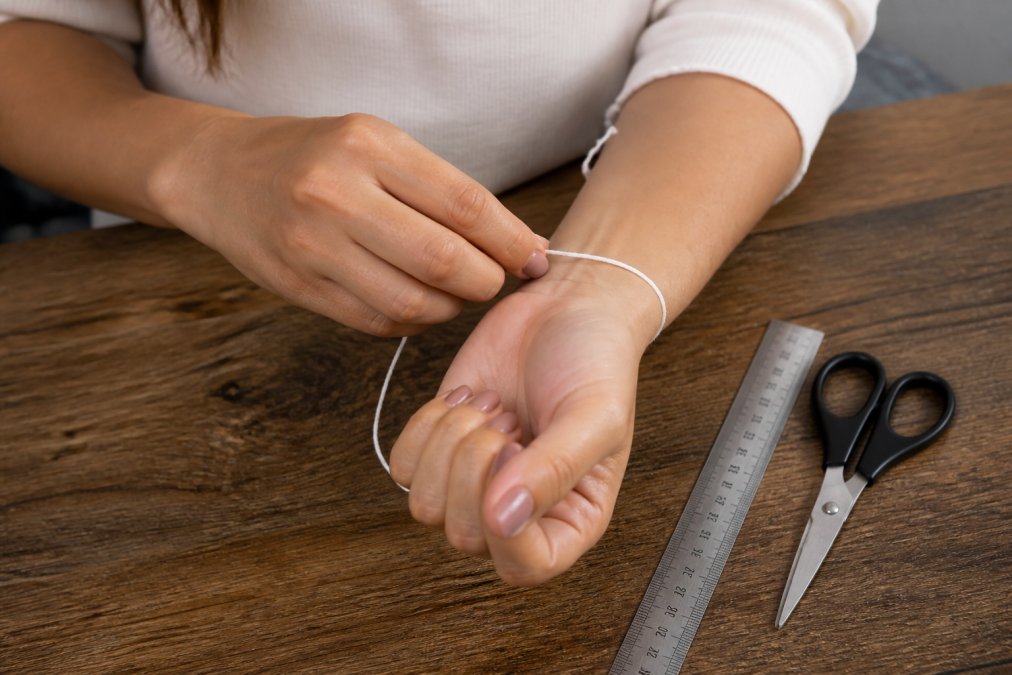
- Wrap the string around your wrist just below the wrist bone.
- Pull it snug, but not tight enough to press into your skin.
- Mark the exact spot where the string overlaps with a pen.
- Lay the string flat on a table and measure from the end to your mark.
- Write down the number in both inches and millimeters.
How to Measure Wrist with a Paper Ruler or Tape
A paper ruler gives you the same result as string with one less step. Print a sizing guide at 100% scale, cut along the marked line, and wrap the paper strip around your wrist.
A few quick checks:
- The tape should sit level, not angled up toward your forearm
- Keep the tape flat against your skin with no twists
- Read the number at eye level to avoid a skewed reading
Bracelet Size Chart: Converting Your Measurement
Once you have your wrist measurement, converting it to a bracelet size takes one step. Add a small amount of length for comfort, then match the total to a standard size.
| Wrist Measurement | Add for Comfort | Bracelet Size | Typical Fit |
|---|---|---|---|
| 5.5 in (140 mm) | 0.5 in (13 mm) | Small | Snug |
| 6.0 in (152 mm) | 0.5 in (13 mm) | Medium | Snug |
| 6.5 in (165 mm) | 0.5 in (13 mm) | Medium-Large | Comfortable |
| 7.0 in (178 mm) | 0.5 in (13 mm) | Large | Comfortable |
| 7.5 in (190 mm) | 0.5 in (13 mm) | X-Large | Loose |
Average Bracelet Size for Women (and How to Adjust for Anyone)
The average bracelet size for women falls between 6.5 and 7 inches (165 to 178 mm), which covers most adult wrists. Men's average bracelet sizes typically run 7.5 to 8 inches (190 to 203 mm). Those are starting points, not rules. Wrist size varies widely with height, frame, and body composition, so a gift that fits one person perfectly can sit loose or tight on another.
How to Measure Someone's Wrist Without Them Knowing
This is the method most sizing guides skip, and it's the one gift shoppers need. You don't need their wrist at all. You need a bracelet they already wear.
The borrowed-bracelet method:
- Find a bracelet they wear often and that fits the way they like.
- Wait until it's off their wrist, on a nightstand, in a jewelry dish, or on a dresser.
- Lay it flat on a table and measure the full length from one end to the other, including the clasp.
- If it's a chain or link bracelet, that total length is their finished bracelet size. Match it.
- If it's a bangle, measure the inside diameter across the widest point instead.
The photo-scale method (when you can't get the bracelet):
- Ask for a photo of them wearing a bracelet, or find one on social media.
- Ask them to hold a common object of known size in the same frame, a quarter (0.955 in / 24.26 mm diameter), a credit card (3.37 in / 85.6 mm long), or a standard soda can (2.6 in / 66 mm diameter).
- Compare the bracelet's width in the photo to the reference object to estimate the wrist circumference.
The ask-a-third-party method:
- Ask a roommate, partner, or close friend to wrap a string around the recipient's wrist while they sleep or while distracted.
- Ask a jewelry-store associate to size them during a shopping trip framed as browsing.
- Ask the recipient directly but casually: "What size bracelet do you wear?" Most people know their ring size but not their bracelet size, so pair it with a visual reference.
Adjustable Styles Remove the Guesswork
When none of the above is possible, choose a design that fits a range of wrists:
- Open cuffs bend to fit and cover roughly a 1-inch range.
- Chain bracelets with extender chains add 1 to 2 inches of adjustability.
- Bolo or slider closures adjust continuously.
- Stretch beaded bracelets fit a narrow band of wrist sizes and are the least forgiving of a wrong guess.
How to Measure Wrist for Different Bracelet Styles
Bracelet style changes how much length you add, and this is where most sizing guides fall short. A number that works for a chain bracelet can feel wrong on a bangle, and a cuff that fits one wrist won't fit the next. Here's how each style actually sizes.
Chain and Link Bracelets
Chain bracelets need the standard half-inch (13 mm) allowance. The links drape, so they sit close to the wrist without pinching. Add the allowance to your wrist circumference and match the total to the bracelet's listed length.
Bangles
Bangles must slide over your hand, not just your wrist. This is the single biggest sizing mistake people make: they measure the wrist and order a bangle that won't clear the knuckles.
Here's the correct method:
- Tuck your thumb into your palm as if you're putting on a bangle.
- Measure around the widest part of your hand, across the knuckles and the base of the thumb.
- That hand width, not your wrist, is the minimum inside diameter the bangle must clear.
Cuffs
Cuffs are open at the back, so they flex to fit. Measure your wrist for a baseline, then adjust the gap by hand for a custom feel. A cuff typically covers about a 1-inch range of wrist sizes, which makes it the most forgiving fixed style.
Beaded Bracelets
Beaded bracelets sit best with a snug fit. Add only a quarter inch (6 mm), or the beads will roll and catch on surfaces. A beaded bracelet that's too loose slides down the hand and clatters; too tight and it leaves marks.
Style-by-Style Sizing Reference
| Bracelet Style | What to Measure | Comfort Allowance | Fits Best When |
|---|---|---|---|
| Chain | Wrist circumference | 0.5 in (13 mm) | Drapes slightly |
| Link | Wrist circumference | 0.5 in (13 mm) | Drapes slightly, watch clasp length |
| Bangle | Hand width (thumb tucked) | Hand width, not wrist | Slides over hand |
| Cuff | Wrist circumference | Adjustable, ~1 in range | Snug, then bent to fit |
| Beaded | Wrist circumference | 0.25 in (6 mm) | Sits close to skin |
| Stretch beaded | Wrist circumference | 0.25 in (6 mm) | Snug, allows for elastic stretch |
Why the Generic Half-Inch Rule Fails
The half-inch rule is a good default for chain and link bracelets, but it breaks down for anything that has to clear the hand or flex to fit. Bangles need hand width. Cuffs need a range, not a number. Beaded styles need less allowance than the rule suggests. If you only remember one thing from this section, remember that the style dictates the measurement, not the other way around.
Common Mistakes to Avoid When Measuring for a Bracelet
Small errors here cost you a return and a missed moment. Most sizing problems trace back to a handful of habits.
- Measuring too tight. A squeezed wrist reads small. Keep the tape resting, not pressing.
- Using a metal tape measure. It won't curve around your wrist, so the reading runs long.
- Measuring above the wrist bone. The wrist bone is your landmark. Measure just below it.
- Forgetting the comfort allowance. Your raw measurement is not your bracelet size.
- Measuring a cold wrist. Cold shrinks the wrist slightly. Measure at room temperature.
- Skipping the double-check. Measure twice. If the two numbers differ, take the average.
Frequently Asked Questions
What size bracelet should I buy if my wrist is 6 inches?
For a 6-inch wrist, a bracelet size of 6.5 to 7 inches usually provides a comfortable fit. This adds about 0.5 to 1 inch of ease, allowing the bracelet to move slightly without feeling tight. For a snug fit, choose 6.25 inches; for a looser fit, go up to 7.25 inches. Always check the specific brand's bracelet size chart, as sizing can vary slightly between designers.
How much extra space should I add to my wrist measurement for a bracelet?
The general rule is to add 0.5 inch for a snug fit, 0.75 inch for a comfortable fit, and 1 inch for a loose fit. This extra length accounts for the bracelet's clasp, the width of the band, and your personal preference. If you're measuring for a gift and unsure, a comfortable fit (0.75 inch extra) is the safest choice for most adults.
Does the type of bracelet affect how I should measure my wrist?
Yes, the style matters. For a chain bracelet or bangle, measure your wrist as described and add the appropriate ease. For a cuff, you'll want a slightly smaller measurement since cuffs are adjustable but should stay in place. For a beaded bracelet, measure snugly because the beads add bulk. Always check the specific sizing guide for the bracelet style you're considering.
How do I measure my wrist without a flexible measuring tape?
Use the string method: wrap a piece of string, ribbon, or even a strip of paper around your wrist, mark where it overlaps, and then lay it flat against a ruler to measure the length. Alternatively, use a printable paper ruler template. Both methods are accurate if you keep the string snug but not tight against your skin.
A bracelet that fits well is the difference between a gift they wear every day and one that sits in a drawer. At Giulia's Jems, every piece is crafted with hand-selected finishing touches and premium materials, and each order includes a personalized message card so your words travel with the gift. Our curated collection of modern classics makes it easy to find something meaningful for a spouse, parent, or child. Shop now and give a piece they'll reach for again and again.