
Table of Contents
- Why Gift Card Messages Matter
- The 5-Step Process for Writing Meaningful Gift Card Messages
- Gift Card Message Examples for Different Occasions
- What to Write in a Gift Card: Practical Guidance
- Short Gift Card Messages That Feel Personal
- Common Mistakes to Avoid
- Personalizing Your Message Without Sounding Generic
- Conclusion
- Frequently Asked Questions
Last Updated: October 13, 2026
Why Gift Card Messages Matter
A thoughtful gift card message transforms a practical gift into something personal and memorable. At Giulia's Jems, we understand that jewelry paired with meaningful words creates lasting emotional impact.

The message you write tells the recipient why you chose this gift and shows you reflected on your relationship. A simple, sincere note can mean more than the gift itself.
Gift card messages matter because they:
- Show genuine thought and care
- Create a personal connection despite the gift's practicality
- Give context to why you selected this specific gift
- Become something the recipient keeps and treasures
When you pair jewelry with meaningful words, you're giving a memory and a reason to think of you every time they wear it.
The 5-Step Process for Writing Meaningful Gift Card Messages
Writing a meaningful gift card message doesn't require flowery language, just honesty and intention. Follow these five steps.

Step 1: Identify the Occasion and Relationship
Start by naming the occasion and your relationship to the recipient.
Ask yourself: Why am I giving this gift right now? Is it a birthday, anniversary, thank-you, or milestone? What does this person mean to me?
Your occasion shapes your tone, and your relationship determines how personal and informal you can be. A birthday message differs from an anniversary message; a note to a spouse differs from one to a colleague.
Step 2: Choose Your Tone
Your tone is the emotional color of your message.
Common tones for gift card messages include:
- Warm and sentimental (for spouses and close family)
- Playful and lighthearted (for friends and younger recipients)
- Respectful and grateful (for mentors, bosses, or professional relationships)
- Sincere and encouraging (for milestone celebrations)
Match your tone to both the occasion and the person: a spouse's anniversary message should feel intimate, a colleague's recognition professional but warm. Read your message aloud before writing it on the card and adjust if it doesn't sound like you.
Step 3: Add a Specific Detail or Shared Memory
This is where your message becomes truly personal. Generic messages feel flat. Specific details make them sing.
Instead of "I'm proud of you," write "I'm proud of you for going back to school while working full-time. That takes courage."
Instead of "Happy birthday," write "Happy birthday to the person who makes me laugh every single day."
A shared memory makes the message irreplaceable. Reference something only you two would know:
- An inside joke
- A moment you both remember
- A quality you admire in them
- A time they showed up for you
This detail takes your message from something anyone could write to something only you could write.
Step 4: Keep It Concise
Gift card space is limited, and short messages often hit harder than long ones.
Aim for 2-4 sentences maximum. Every word should matter. A concise message is easier to read, remember, and treasure, and short doesn't mean cold: a two-sentence message can be deeply meaningful if it's specific and honest.
Step 5: Close with a Warm Sign-Off
End with a closing that matches your tone and relationship.
Warm sign-offs for personal relationships:
- With all my love
- Always yours
- With deep appreciation
- Thinking of you always
- Forever grateful
Professional but warm sign-offs:
- With gratitude
- Warmly
- Best wishes
- In appreciation
Your sign-off is the last thing they read. Make it count.
| Step | Purpose | Key Action |
|---|---|---|
| Identify occasion and relationship | Ground your message in context | Name why you're giving this gift and who the person is to you |
| Choose your tone | Set the emotional color | Match tone to occasion and relationship |
| Add specific detail | Make it personal | Reference a shared memory, inside joke, or specific quality |
| Keep it concise | Maximize impact | Write 2-4 sentences maximum |
| Close with warm sign-off | End on a meaningful note | Choose a closing that matches your tone |
Gift Card Message Examples for Different Occasions
Use these examples as inspiration, then adapt them to your own voice and relationship.
Birthday Messages
Birthday messages celebrate the person, not just the date.
Example 1 (for spouse): "Another year older, and somehow you're more beautiful to me than ever. Thank you for being my person.
Example 2 (for parent): "You taught me everything that matters. Happy birthday to the strongest person I know."
Example 3 (for friend): "One year closer to becoming the person you're meant to be.
Example 4 (for adult child): "Watching you grow into the person you are has been one of my greatest joys.
Anniversary Gift Card Messages
Anniversary messages celebrate your relationship and why you're still choosing your partner.
Example 1 (for spouse): "Every year with you feels like the best choice I ever made. Here's to many more. I love you."
Example 2 (romantic): "You're my favorite person to do life with. Thank you for choosing me, every single day."
Example 3 (reflective): "We've built something beautiful together. I can't wait to see what the next chapter holds."
Example 4 (playful): "Still crazy about you. Still grateful for you. Still yours."
Thank-You and Appreciation Messages
Thank-you messages acknowledge someone's kindness and show their actions mattered.
Example 1 (for mentor): "You believed in me when I didn't believe in myself. Thank you for everything you've taught me."
Example 2 (for parent): "Thank you for always showing up, always listening, and always loving me.
Example 3 (for friend): "You were there when I needed you most. That's what true friendship looks like. Thank you."
Example 4 (for colleague): "Working with you has made me better at what I do.
Congratulations and Milestone Messages
Milestone messages celebrate achievements and transitions, acknowledging hard work and growth.
Example 1 (for graduation): "You did it. And I knew you would. I'm so proud of you.
Example 2 (for promotion): "This promotion is exactly what you deserve. You work harder than anyone I know. Congratulations."
Example 3 (for new home): "A new chapter in your story begins here.
Example 4 (for new baby): "Welcome to the most beautiful, exhausting, rewarding adventure of your life. You're going to be an amazing parent."
What to Write in a Gift Card: Practical Guidance
Knowing what to include in a gift card message helps you stay focused.
Start with why.
"I chose this for you because you deserve to feel beautiful every time you wear it."
"This reminded me of you and how much you mean to me."
"I wanted to give you something timeless, just like our love."
Heartfelt Expressions: A Love Message Journal to Cherish Your Thoughts →
Next, add your specific detail or memory, then close with a sentiment or sign-off that feels authentic.
Your message should take up most of the available space without feeling cramped.
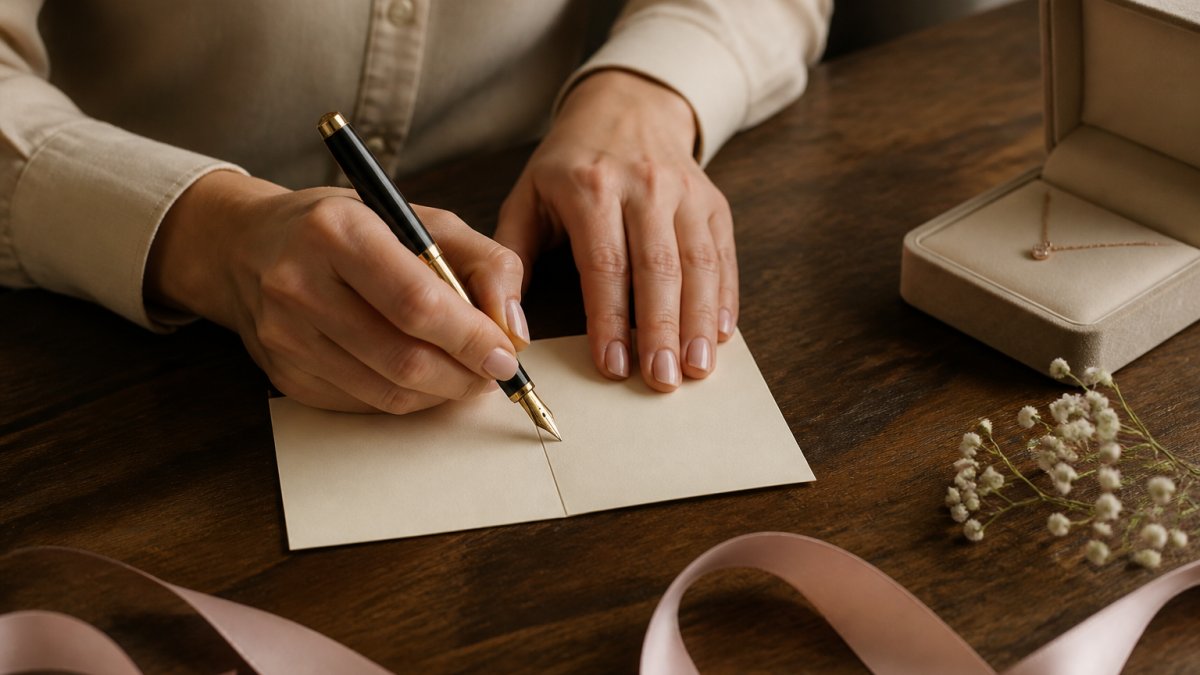
On a physical gift card, use a pen that won't smudge; black or blue ink is most readable, and pencil fades over time.
Short Gift Card Messages That Feel Personal
Sometimes the best messages are the shortest ones.
Examples of short, powerful messages:
"You're my favorite person.", For a spouse or close partner
"I'm so proud of you.", For a child or mentee
"Thank you for being you.", For anyone who's made a difference
"You deserve this.", For someone who's worked hard or overcome challenges
"Here's to you and everything you're becoming.", For milestone moments
"Still crazy about you.", For anniversaries
"You matter more than you know.", For someone who doubts themselves
The key is specificity. Every word must earn its place, so remove anything generic and keep only what's true and meaningful.
Common Mistakes to Avoid
Even with good intentions, certain patterns weaken gift card messages.
Mistake 1: Being too generic
Generic messages could apply to anyone. They feel impersonal and forgettable.
Weak: "Happy birthday. Hope you have a great day."
Strong: "Happy birthday to the person who makes every day an adventure.
Mistake 2: Trying too hard
Forced poetry or over-the-top language feels inauthentic.
Strong: "Happy birthday. I'm so glad you're here."
Mistake 3: Making it about you
A gift card message should celebrate or acknowledge the recipient, not talk about yourself.
Weak: "I'm so excited to give you this gift because I love giving gifts."
Mistake 4: Being too long
Long messages get cramped on small cards. They're also harder to reread and remember.
Weak: A paragraph that fills the entire card
Strong: 2-4 sentences that say what matters most
Mistake 5: Using clichés without context
Clichés feel lazy.
Weak: "You're one in a million."
Personalizing Your Message Without Sounding Generic
Start by brainstorming. Before you write, ask yourself:
- What's one thing this person does that no one else does?
- What's a moment we shared that only we remember?
- What quality do I admire most in them?
- Why did I choose this gift specifically for them?
Write down your answers. These become the details that personalize your message.
Example: You're giving a necklace to your mother. Instead of "Happy Mother's Day," you write:
"Happy Mother's Day to the woman who taught me strength by example. Every time I wear this, I'll think of you."
That detail, "taught me strength by example", is specific to your relationship. You can also reference inside jokes or shared experiences:
"Remember when we said we'd always have each other's backs? This is me keeping that promise."
"You've been my rock through everything. This is a small way of saying thank you."
Personalization requires honesty, not perfect words. Write what you actually feel, not what you think sounds good.
Test your personalization by reading it aloud. Does it sound like you? Does it reference something only this person would recognize?
Conclusion
A meaningful gift card message transforms a gift into a keepsake, telling the recipient why they matter to you and why you chose this present.
The five-step process, identify your occasion, choose your tone, add a specific detail, keep it concise, and close warmly, works for any relationship and occasion. Your message doesn't need to be long or poetic, just honest and specific.
When you pair a thoughtful message with a beautiful piece of jewelry from Giulia's Jems, you're giving something that will be worn, remembered, and treasured for years. Whether you're celebrating an anniversary, milestone, or simply saying "I love you," Giulia's Jems helps you create a gift that speaks to the heart. Shop now and discover how the perfect piece paired with your words creates lasting memories.
Frequently Asked Questions
How do I make a short gift card message feel personal?
Include a specific detail that only you and the recipient would know, such as a shared memory, inside joke, or reference to something they've mentioned. Instead of 'Enjoy this gift,' try 'Remember when you said you wanted to try that new restaurant? Now you can.' Specific references transform generic messages into heartfelt ones, even when space is limited.
What should I write in a gift card for an anniversary?
Anniversary messages work best when they celebrate your relationship journey. Try: 'Every year with you is a gift I treasure. Here's to many more memories together.' Or reference a meaningful moment: 'Ten years ago you said yes, and I've been grateful every day since. I love you.' Keep the tone sincere, mention your gratitude, and focus on your shared future rather than generic sentiments.
Should a gift card message be funny or heartfelt?
Match the message to the recipient's personality and your relationship. If they appreciate humor, a light joke can work: 'You deserve something special, and I'm too lazy to wrap it properly, so here's a gift card.' For closer relationships or milestone occasions like anniversaries, heartfelt messages create more lasting impact. Many people appreciate a balance: warmth with a touch of humor.
How long should a gift card message be?
Most gift cards have space for 2-4 sentences. Aim for 30-50 words. Longer messages risk looking cramped or forced on a small card, while shorter ones can feel impersonal. Focus on quality over length: one genuine, specific sentence beats three generic ones. If you're including a message with jewelry from Giulia's Jems, the personalized message card gives you room to express yourself fully without space constraints.